
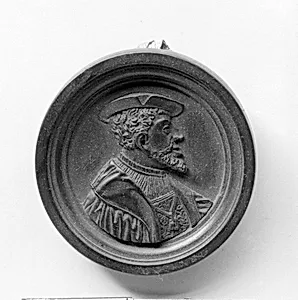
Charles V (1500–1588)
Unknown Artist
16th century
Medium
Boxwood
Dimensions
Diameter: 2 in. (5.1 cm)
Classification
Sculpture-Miniature
Culture
German
Department
European Sculpture and Decorative Arts
Museum
Metropolitan Museum of Art, New York, NY
Credit
Gift of Mrs. Edward S. Harkness, 1930
Accession Number
30.135.9
Rights
Public Domain
Tags
Art Historical Context
This delicate boxwood miniature, titled *Charles V (1500–1558)*, is a remarkable 16th-century German measuring just 2 inches (5.1 cm) in. Crafted by an unknown artist it captures the profile of the Holy Roman Emperor V in a classical medallion style, showcasing the era's fascination with portraiture in miniature form. Housed in the Metropolitan Museum of Art's Department of European Sculpture and Decor Arts, it was generously gifted by Mrs. Edward S. Harkness in 1930. Boxwood, a dense and fine-grained hardwood, was the ideal medium for such intricate carvings, allowing sculptors to achieve extraordinary detail in tiny scales. These miniatures, often worn as pendants or set into jewelry, blended Renaissance humanism with Northern European precision, emphasizing imperial authority through sharp profiles and subtle modeling. Charles V's reign (1519–1556) marked a golden age of Habsburg power, spanning vast territories from Spain to the Americas, making this portrait a portable emblem of his legacy. Though small, this work invites close inspection, revealing the technical virtuosity of German Renaissance craftsmen. It exemplifies how decorative arts democratized grand portraiture, bridging sculpture and personal adornment in an age of exploration and empire.