
Chasse of Champagnat
Unknown Artist
ca. 1150
Medium
Copper: engraved and gilt; champlevé enamel: blue-black, medium blue, turquoise, green, red, and white
Dimensions
Overall (Chasse): 4 7/8 x 7 7/16 x 3 3/8 in. (12.4 x 18.9 x 8.5 cm) Overall (Plaque): 2 3/4 x 7 7/16 x 1/16 in. (7 x 18.9 x 0.2 cm)
Classification
Enamels-Champlevé
Culture
French
Department
Medieval Art
Museum
Metropolitan Museum of Art, New York, NY
Credit
Gift of J. Pierpont Morgan, 1917
Accession Number
17.190.685–87, .695, .710–.711
Rights
Public Domain
Tags
About this artwork
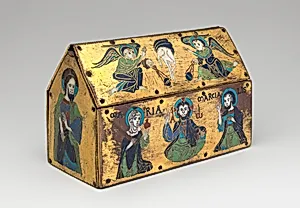
This reliquary casket, or chasse, represents the pinnacle of Limoges enamel work during the Romanesque period. The principal face presents Christ at the center, distinguished by his cruciform halo and holding a book while raising his right hand in blessing. Flanking Christ are two saints: Mary Magdalene (identified as "Maria"), holding an unguent jar and palm frond, and Martial ("Marcialis"), the first bishop of Limoges and patron saint of the Limousin region. Above, a roof plaque depicts the ha...
Art Historical Context
Step into the luminous world of 12th-century Limoges enamels with the *Chasse of Champagnat*, a exquisite reliquary casket crafted around 1150. This small copper treasure chest, originally housing sacred relics of Saint Martial—the first bishop of Limoges and revered as the "thirteenth apostle"—in the church of Saint-Martial at Champagnat, exemplifies Romanesque artistry at its peak. The principal face centers Christ with his cruciform halo, book, and blessing hand, flanked by Mary Magdalene (with her unguent jar and palm) and Saint Martial. A rooftop plaque shows the Hand of God amid angels with censers, alpha and omega symbols underscoring eternal divinity. Masterfully executed in champlevé enamel, the technique involved engraving recessed cells into gilt copper, filling them with vibrant vitreous enamels in blues, turquoise, greens, reds, and white for a jewel-like glow. This contrasted brilliantly with the shimmering gold, drawing worshippers' eyes during liturgy. Limoges workshops dominated medieval Europe's enamel production, exporting to churches across Christendom for their technical brilliance and spiritual power. Gifted to the Metropolitan Museum of Art by J. Pierpont Morgan in 1917, this chasse captures the Gilded Age fascination with Romanesque treasures, blending devotion, craftsmanship, and history in one radiant object.