
Chastity Plaque
Unknown Artist
14th century
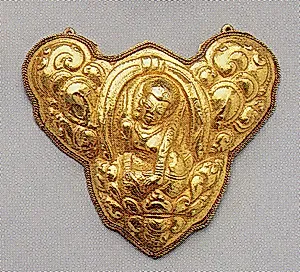
Medium
Gold
Dimensions
3 x 3 3/4 in. (7.6 x 9.5 cm)
Classification
Metalwork
Culture & Period
Indonesia (Java) · Majapahit period (1296–1520)
Department
Asian Art
Museum
Metropolitan Museum of Art, New York, NY
Credit
The Samuel Eilenberg-Jonathan P. Rosen Collection of Indonesian Gold, Bequest of Samuel Eilenberg and Gift of Jonathan P. Rosen, 1998
Accession Number
1998.544.5
Rights
Public Domain
Art Historical Context
This exquisite **Chastity Plaque**, crafted in the 14th century during Java's Majapahit period (1296–1520), exemplifies the refined gold metalwork of Indonesia's golden age. Measuring just 3 x 3¾ inches (7.6 x 9.5 cm), this small yet intricate piece from an unknown artist was likely worn as a pendant or amulet, symbolizing purity and moral virtue in a Hindu-Buddhist society where such talismans offered spiritual protection. The Majapahit Empire, at its height under rulers like Hayam Wuruk, was a maritime powerhouse blending Indian influences with local Javanese artistry. Gold, a precious medium reserved for elites, was hammered, chased, and engraved to create delicate motifs—techniques that highlight the era's mastery of metalwork. Chastity plaques like this one underscore the cultural emphasis on ethical ideals amid temple grandeur and courtly splendor. Now part of the Metropolitan Museum of Art's Asian Art collection, thanks to the Samuel Eilenberg-Jonathan P. Rosen bequest (1998), it invites us to ponder the intimate role of jewelry in daily devotion and status. A tiny treasure revealing a vast empire's soul.