
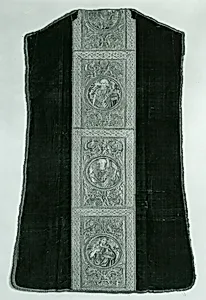
Chasuble, Back
Unknown Artist
16th century
Medium
Cut velvet with embroidered and couched orphrey; silk, gilt-metal-strip-wrapped silk, linen.
Dimensions
47 x 30 in. (119.4 x 76.2 cm)
Classification
Textiles-Ecclesiastical
Culture
Italian or Spanish
Department
Robert Lehman Collection
Museum
Metropolitan Museum of Art, New York, NY
Credit
Robert Lehman Collection, 1975
Accession Number
1975.1.1837B
Rights
Public Domain
Tags
Art Historical Context
This stunning 16th-century chuble back, from the Robert Lehman Collection at The Metropolitan Museum of Art, the opulent ecclesiastical textiles of Renaissance Italy or Spain. A chasuble is the ornate outer vestment worn by priests during Mass, with this panel forming the dramatic rear view. Measuring 47 x 30 inches, it would have draped elegantly over the celebrant's shoulders, transforming the liturgy into a visual feast of splendor. Crafted from luxurious cut velvet—where the pile is precisely sheared to reveal intricate patterns—the piece features an embroidered and couched orphrey, a stiffened band of decoration running down the center. Couched work involves laying down silk and gilt-metal-strip-wrapped threads, then securing them with fine stitches, creating a shimmering, three-dimensional effect that catches the light in church settings. These techniques highlight the era's mastery of textile arts, blending weaving, embroidery, and metalwork for divine radiance. In the 16th century, amid Catholic Counter-Reformation fervor, such vestments symbolized the Church's enduring wealth and piety, often commissioned by nobility for special ceremonies. Though the artist remains unknown, this artifact's gilt accents and rich silk evoke the cultural crossroads of Italian and Spanish Renaissance workshops, inviting us to imagine priests resplendent under candlelight. (198 words)