
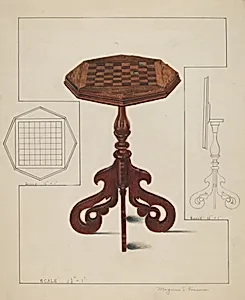
Checker-board Table-tilt Top
c. 1936
Medium
watercolor, colored pencil, graphite, and heightening on paper
Dimensions
overall: 28 x 22.7 cm (11 x 8 15/16 in.) Original IAD Object: 28"high; 21"diameter
Classification
Index of American Design
Department
CG-W
Museum
National Gallery of Art, Washington, D.C.
Credit
Index of American Design
Accession Number
1943.8.5566
Rights
Public Domain
Art Historical Context
**Checker-board Table-tilt Top** *Magnus S. Fossum, c. 1936* Watercolor, colored pencil,, and heightening on paper, 28 x 22.7 cm (11 x 8 15/16 in.) *Index of American Design, National Gallery of Art* This vibrant rendering by Magnus S. Fossum a charming tilt-top table designed for checkerboard games, standing 28 inches high with a 21-inch diameter. The detailed depiction highlights the table's functional elegance—a clever American furniture form where the surface tilts for play and storage, blending utility with leisure in everyday life. Created as part of the Index of American Design (IAD), a Federal Art Project under the Works Progress Administration (WPA) from 1935 to 1942, this work exemplifies efforts to document and celebrate America's folk and decorative arts during the Great Depression. Artists like Fossum produced precise, scaled drawings to preserve cultural heritage, ensuring that humble objects like this gaming table were recognized for their craftsmanship and ingenuity. Fossum's masterful use of watercolor for rich color, colored pencil and graphite for fine lines, and heightening for luminous highlights brings the wood grain, checkerboard pattern, and turned pedestal to life on paper. As a testament to 20th-century American design, it invites us to appreciate how such pieces fostered community and play, bridging art, history, and domestic joy.
About the Artist
Magnus S. Fossum · 1888–1980
Magnus S. Fossum is an artist for whom biographical documentation is sparse. No confirmed birth or death dates have been established, and his national or regional origin remains uncertain, making a full account of his artistic training and career difficult to construct from available sources. The works attributed to Fossum that have been preserved in museum collections provide the most direct win...