
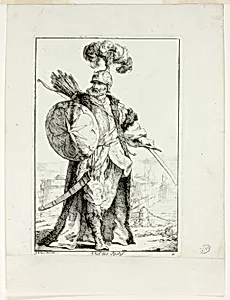
Chef des Spahis, plate two from Caravanne du Sultan à la Mecque
Medium
Etching on ivory laid paper
Dimensions
Image: 19.7 × 13.3 cm (7 13/16 × 5 1/4 in.); Plate: 20.5 × 13.8 cm (8 1/8 × 5 7/16 in.); Sheet: 23.6 × 20.2 cm (9 5/16 × 8 in.)
Classification
etching
Department
Prints and Drawings
Museum
Art Institute of Chicago
Accession Number
207694
Rights
Public Domain
Art Historical Context
Step into the exotic world of 18th-century Europe *Chef des Spahis plate two from Joseph-Marie Vien's series *Caranne du Sultan à la Mecque* (The Sultan's Caravan to Mecca created in 1748 Vien, a pioneering French artist bridging Rococo elegance and emerging Neoclassicism, the grandeur of Ottoman pageantry through this intimate etching. The image portrays the commanding "Chef des Spahis leader of the elite cavalry corps in the Ottoman Empire, evoking the splendor of a royal pilgrimage. Etched on delicate ivory laid paper, this print measures a modest 19.7 × 13.3 cm, yet its fine lines—achieved by acid biting into a metal plate—convey intricate details of turbans, flowing robes, and ornate weaponry. Etching allowed Vien to disseminate these Orientalist visions widely, fueling Europe's fascination with the "exotic" East amid Enlightenment curiosity about distant cultures. Housed in the Art Institute of Chicago's Prints and Drawings Department, this work highlights Vien's early mastery of printmaking and his role in popularizing imagined Islamic splendor. A window into pre-Romantic Orientalism, it invites us to ponder how art transported 18th-century viewers to the sands of Mecca.
About the Artist
Joseph Marie Vien, I · 1716–1809
Joseph-Marie Vien (1716–1809) was born in Montpellier and trained in Paris under Charles-Joseph Natoire. A brilliant student, he won the Prix de Rome in 1743 and spent the years 1744 to 1750 at the French Academy in Rome, where his encounter with the antiquarian scholarship of the Comte de Caylus and the early stirrings of neoclassical taste around the discoveries at Herculaneum and Pompeii proved...