
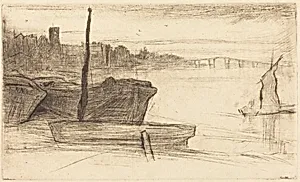
Chelsea Bridge and Church
c. 1870/1871
Medium
etching and drypoint on laid paper
Dimensions
plate: 10.16 x 16.51 cm (4 x 6 1/2 in.) sheet: 12.7 x 19.37 cm (5 x 7 5/8 in.)
Classification
Department
CG-W
Museum
National Gallery of Art, Washington, D.C.
Credit
Rosenwald Collection
Accession Number
1943.3.8459
Rights
Public Domain
Art Historical Context
James McNeill Whistler’s *Chelsea Bridge and Church*c. 1870/1871) captures a serene moment along London’s Thames River, part of the artist’s renowned Thames Set—a series of etchings documenting the waterway’s industrial and everyday life. Living in Chelsea during this period, Whistler drew inspiration from the neighborhood’s bridges, wharves, and churches, blending realism with his emerging aesthetic philosophy that prioritized mood and harmony over literal detail. This intimate print reflects the gritty yet poetic urban landscape of Victorian London, evoking a sense of quiet reflection amid the city’s bustle. Masterfully executed in etching and drypoint on laid paper, the work showcases Whistler’s innovative printmaking techniques. Etching creates precise lines through acid on a metal plate, while drypoint adds velvety textures from a burr raised by direct needle work—resulting in subtle tonal gradients and atmospheric depth. Measuring just 10.16 x 16.51 cm on the plate, its small scale invites close viewing, much like a whispered secret. Housed in the National Gallery of Art’s Rosenwald Collection, this print exemplifies Whistler’s influence on modern art, bridging 19th-century realism with the impressionistic focus on light and suggestion that defined his later career.
About the Artist
James McNeill Whistler · 1834–1903
James Abbott McNeill Whistler (1834-1903) was an American-born painter and printmaker who became a leading figure in the Aesthetic Movement and pioneer of Tonalism and Japonisme. He revolutionized art by championing "art for art's sake" and treating paintings as visual equivalents of musical compositions, titling works as "arrangements," "harmonies," and "nocturnes" to emphasize formal qualities o...