
Chelsea Rags
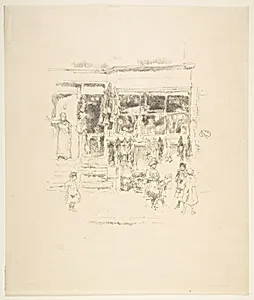
Medium
Transfer lithograph, printed in black ink on cream India wove; only state (Chicago)
Dimensions
Image: 7 1/16 × 6 1/4 in. (18 × 15.9 cm) Sheet: 10 11/16 × 9 1/8 in. (27.2 × 23.2 cm)
Classification
Prints
Department
Drawings and Prints
Museum
Metropolitan Museum of Art, New York, NY
Credit
Harris Brisbane Dick Fund, 1917
Accession Number
17.3.174
Rights
Public Domain
Tags
Art Historical Context
James McNeill Whistler’s *Chelsea Rags* (1888) captures the gritty charm of London’s Chelsea neighborhood, where the artist lived and worked during the late Victorian era. This transfer lithograph depicts human figures amid urban buildings, likely evoking the everyday lives of working-class residents—perhaps rag pickers or street vendors—against a backdrop of bustling city architecture. Whistler, a pioneer of the Aesthetic movement, prioritized mood and harmony over narrative detail, infusing his prints with subtle tonal effects that blur the line between realism and abstraction. Printed in black ink on luxurious cream India wove paper, the work is a rare “only state” from the Chicago edition, highlighting Whistler’s mastery of lithography. In this technique, he drew on transfer paper before pressing it onto a lithographic stone, allowing for delicate lines and velvety textures that mimic etching’s precision while embracing the medium’s fluidity. At just 7 1/16 × 6 1/4 inches, its intimate scale invites close viewing, revealing the artist’s innovative approach to printmaking. Housed in The Metropolitan Museum of Art’s Drawings and Prints department (acquired via the Harris Brisbane Dick Fund in 1917), *Chelsea Rags* exemplifies Whistler’s influence on modern art. It bridges 19th-century urban observation with modernist experimentation, offering visitors a window into the social textures of industrial London through one of America’s most cosmopolitan artists.
About the Artist
James McNeill Whistler · 1834–1903
James Abbott McNeill Whistler (1834-1903) was an American-born painter and printmaker who became a leading figure in the Aesthetic Movement and pioneer of Tonalism and Japonisme. He revolutionized art by championing "art for art's sake" and treating paintings as visual equivalents of musical compositions, titling works as "arrangements," "harmonies," and "nocturnes" to emphasize formal qualities o...