
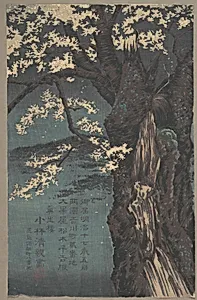
Cherry Tree
dated 1874
Medium
Woodblock print; ink and color on paper
Dimensions
14 x 8 5/16 in. (35.6 x 21.1 cm)
Classification
Prints
Culture & Period
Japan · Meiji period (1868–1912)
Department
Asian Art
Museum
Metropolitan Museum of Art, New York, NY
Credit
Bequest of Gustave von Groschwitz, 1993
Accession Number
1993.310
Rights
Public Domain
Tags
Art Historical Context
Kobayashi Kiyochika *Cherry Tree* (1874) captures the delicate beauty of Japan's iconic sakura during the early Meiji period (1868–1912), a time of profound transformation as Japan rapidly modernized and opened to Western influences. As one of the last masters of the ukiyo-e tradition, Kiyochika bridged classical Japanese printmaking with emerging techniques inspired by European art, such as subtle gradations of light and shadow This woodblock print, a compact 14 x 8 5/16 inches, exemplifies his skill in rendering nature's fleeting elegance amid societal change. Printed with ink and color on paper through the collaborative ukiyo-e process—where artists designed, carvers shaped woodblocks, and printers applied pigments—this medium made art accessible to everyday people. Kiyochika's focus on a single cherry tree evokes hanami, the cherished cultural practice of cherry blossom viewing, symbolizing life's impermanence (mono no aware). Though modest in scale, the print's vibrant hues and intricate details highlight his innovative approach, preserving poetic naturalism in an era of industrialization. Housed in the Metropolitan Museum of Art's Asian Art collection, this bequest from Gustave von Groschwitz offers visitors a window into Meiji Japan's artistic resilience. A serene reminder of enduring traditions!
About the Artist
Kobayashi Kiyochika · 1847–1915
Japanese, 1847–1915