
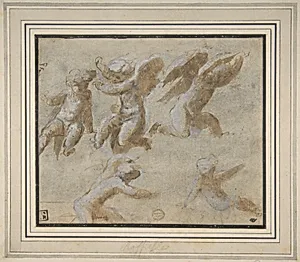
Cherubs
16th century
Medium
Pen and brown ink, washed, highlighted with white
Dimensions
6 1/2 x 7 1/4 in. (16.5 x 18.4 cm)
Classification
Drawings
Department
Drawings and Prints
Museum
Metropolitan Museum of Art, New York, NY
Credit
Rogers Fund, 1906
Accession Number
06.1051.14
Rights
Public Domain
Art Historical Context
Raphael, one of the towering figures of the High Renaissance, created this delicate drawing of cherubs in the 16th century. As a master draftsman, Raphael frequently produced such studies to explore the graceful forms and expressions that would later appear in his celebrated frescoes and altarpieces. The small scale—roughly the size of a postcard—suggests an intimate working process, allowing the artist to refine the soft, rounded contours and playful interactions of these heavenly figures. Executed in pen and brown ink with delicate washes and white highlights, the drawing demonstrates Raphael’s skillful handling of light and volume on paper. This technique was essential for Renaissance artists, enabling quick yet precise modeling of forms that captured both movement and serenity. The subtle tonal contrasts bring a sense of depth and luminosity to the cherubs, reflecting the period’s fascination with idealized beauty and divine innocence. Acquired by the Metropolitan Museum of Art in 1906 through the Rogers Fund, this work offers visitors a rare glimpse into Raphael’s creative mind. It underscores the enduring cultural importance of cherubs as symbols of purity and celestial joy in Western art, inviting us to appreciate the quiet mastery behind the Renaissance’s most iconic images.