
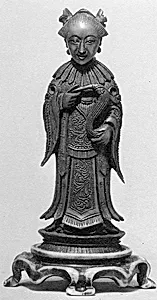
Chess piece
Unknown Artist
late 19th century
Medium
Ivory
Dimensions
H. 3 7/8 in. (9.8 cm)
Classification
Ivories
Culture & Period
China · Qing dynasty (1644–1911)
Department
Asian Art
Museum
Metropolitan Museum of Art, New York, NY
Credit
Alfred W. Hoyt Collection, Bequest of Rosina H. Hoppin, 1965
Accession Number
65.86.134
Rights
Public Domain
Tags
Art Historical Context
This exquisite ivory chess piece, crafted in late 19th-century China during the Qing dynasty (1644–1911), stands just 3 7/8 inches (9.8 cm) tall, a testament to the miniaturist's extraordinary skill. Likely depicting a female figure—hinted by its thematic tags—it forms part of a game set, blending functionality with artistry. Housed in the Metropolitan Museum of Art's Asian Art Department as part of the Alfred W. Hoyt Collection (bequest of Rosina H. Hoppin, 1965), it exemplifies the delicate ivories classification prized by collectors. Ivory carving reached new heights in Qing China, where artisans transformed elephant tusk into luminous, tactile sculptures using fine tools to achieve intricate details in miniature form. This medium's translucency and workability allowed for lifelike expressions and flowing robes, often adorning scholar's objects or leisure games like xiangqi (Chinese chess). Such pieces reflected the era's opulent craftsmanship, favored by the imperial court and elite for their symbolic refinement. Culturally, these ivories highlight Qing society's appreciation for harmonious beauty in everyday pursuits, bridging art and play. Though the artist remains unknown, the piece's survival underscores ivory's enduring allure—and modern reflections on ethical sourcing—inviting us to marvel at a bygone era's ingenuity.