
Chessboard
Unknown Artist
third quarter 17th century
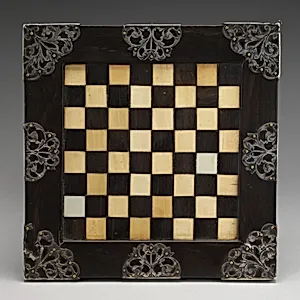
Medium
Ivory, ebony, silver
Dimensions
Overall: 7 × 7 in. (17.8 × 17.8 cm)
Classification
Chess Sets
Culture
British
Department
European Sculpture and Decorative Arts
Museum
Metropolitan Museum of Art, New York, NY
Credit
Bequest of Irwin Untermyer, 1973
Accession Number
1974.28.162
Rights
Public Domain
Tags
Art Historical Context
This exquisite chessboard, crafted by an unknown British artist in the third quarter of the17th century, exemplifies the opulence of Restoration-era decorative arts. Measuring a compact 7 × 7 inches (17.8 × 17.8 cm), it features alternating squares of finely carved ivory and polished ebony, accented with silver inlays that catch the light with subtle elegance. These luxury materials—ivory from elephant tusks, ebony from dense African hardwoods, and sterling silver—were hallmarks of high-end craftsmanship, reserved for the aristocracy and reflecting the era's fascination with exotic imports and technical virtuosity. Chess, introduced to Europe centuries earlier via the Islamic world, surged in popularity during the 1600s as a gentlemanly pursuit symbolizing intellect and strategy. In Britain, post-Civil War prosperity under Charles II fueled demand for such refined gaming boards, often displayed as conversation pieces in grand country houses. The intricate inlay techniques here showcase the miniaturist's skill, where precise joinery ensured durability and aesthetic harmony. Now housed in The Metropolitan Museum of Art's Department of European Sculpture and Decorative Arts, thanks to the 1973 bequest of collector Irwin Untermyer, this chessboard invites us to ponder the leisure of bygone elites—where every move on its surface was both game and art.