
Chessmen (32)
Unknown Artist
19th century
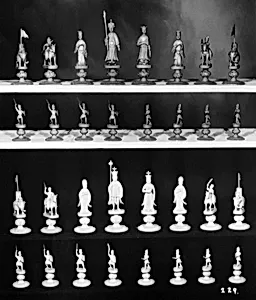
Medium
Ivory
Dimensions
Height (each king): 4 1/2 in. (11.4 cm); Height (each pawn): 2 in. (5.1 cm)
Classification
Chess Sets
Culture
Chinese
Department
European Sculpture and Decorative Arts
Museum
Metropolitan Museum of Art, New York, NY
Credit
Gift of Gustavus A. Pfeiffer, 1953
Accession Number
53.71.181a–p, aa–pp
Rights
Public Domain
Tags
Art Historical Context
These exquisite ivory chessmen, comprising a complete set of 32 pieces hail from 19th-century China and showcase the masterful carving skills of anonymous artisans. Crafted from elephant ivory—a prized medium prized for its smooth texture and ability to capture fine details—the kings stand at 4½ inches (11.4 cm) tall, while pawns measure 2 inches (5.1 cm), making them perfectly scaled for intimate play. Donated to the Metropolitan Museum of Art in 1953 by Gustavus A. Pfeiffer, they now reside in the European Sculpture and Decorative Arts department, highlighting their appeal to Western collectors. Ivory carving flourished in 19th-century China, particularly in coastal export hubs like Canton (Guangzhou), where artisans produced luxurious goods for international trade amid the Opium Wars and opening of treaty ports. These chessmen likely represent this vibrant export tradition, adapting the Western game of chess—itself evolved from ancient Indian chaturanga—to Chinese craftsmanship. The pieces blend functionality with artistry, their compact forms demanding precision in sculpting miniature figures, armor, and symbols. Culturally, they embody East-West exchange, bridging Chinese sculptural expertise with Europe's fascination for chess as both pastime and metaphor for strategy. A delightful fusion of play and portability, these chessmen invite visitors to ponder the global journeys of everyday luxuries.