
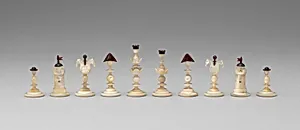
Chessmen (32) and box-board
Unknown Artist
19th century
Medium
Mother-of-pearl, wood, tortoiseshell
Dimensions
Height (each king): 2 1/2 in. (6.4 cm); Height (each pawn): 1 1/4 in. (3.2 cm); Overall (board): 12 × 12 in. (30.5 × 30.5 cm)
Classification
Chess Sets
Culture
British
Department
European Sculpture and Decorative Arts
Museum
Metropolitan Museum of Art, New York, NY
Credit
Gift of Gustavus A. Pfeiffer, 1953
Accession Number
53.71.195a–p, aa–pp, q
Rights
Public Domain
Tags
Art Historical Context
This exquisite 19th-century British set, comprising 32 chessmen and a compact box-board, exemplifies the Victorian era's fascination with elegant pastimes and fine craftsmanship. Housed in the Metropolitan Museum Art's Department of European Sculpture and Decor Arts, the set was a generous gift from Gustavus. Pfeiffer in 1953. Its petite scale—kings standing just 2½ inches tall and pawns 1¼ inches, with a 12×12-inch board—suggests it was designed for intimate, portable play, perhaps during travel or social gatherings among the leisure class. Crafted from luxurious mother-of-pearl, wood, and tortoiseshell, the pieces highlight masterful inlay techniques popular in British decorative arts. Mother-of-pearl, sourced from seashells, provides a luminous iridescence, while tortoiseshell adds rich, glossy warmth; these opulent materials elevated everyday games into status symbols, blending functionality with artistry. Chess sets like this reflect Britain's 19th-century cultural boom in board games, fueled by intellectual clubs and colonial influences. Though the artist remains unknown, the set's refined execution underscores the anonymous skill of period artisans, offering visitors a tangible glimpse into Victorian refinement and recreation.