
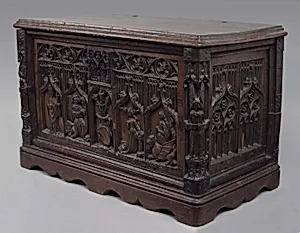
Chest
Unknown Artist
late 15th century
Medium
Walnut, iron
Dimensions
Overall: 18 1/2 x 15 1/4 x 29 7/8 in. (47 x 38.7 x 75.9 cm)
Classification
Woodwork-Furniture
Culture
French
Department
Medieval Art
Museum
Metropolitan Museum of Art, New York, NY
Credit
Gift of J. Pierpont Morgan, 1916
Accession Number
16.32.106
Rights
Public Domain
Tags
Art Historical Context
This elegant walnut chest, crafted in late 15th-century France, exemplifies the artistry of medieval woodwork at the cusp of the Renaissance. Measuring about 19 by 15 by 30 inches, it features sturdy iron fittings for security and durability, typical of household furniture designed to safeguard valuables, linens, dowry goods. Adorned with carved motifs of crosses and human figures—likely in shallow relief—the chest reflects the era's deep religious devotion, blending functional design with symbolic decoration. In the Medieval Art collection of The Metropolitan Museum of Art, gifted by J. Pierpont Morgan in 1916, this piece highlights French carpentry techniques. Walnut, prized for its rich grain and workability, was carved with precision to evoke spiritual narratives, possibly scenes of piety or martyrdom. Such coffres served as status symbols in prosperous homes, underscoring the intersection of daily life and faith during the Late Gothic period. Visitors will appreciate how this unassuming chest reveals the craftsmanship of an unknown artisan, preserving a tangible link to medieval domestic culture.