
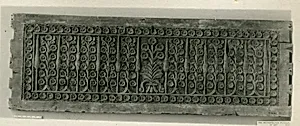
Chest Front
Unknown Artist
18th century
Medium
Wood (walnut); carved
Dimensions
H. 21 1/2 in. (54.6 cm) W. 64 1/2 in. (163.8 cm) D. 1 in. (2.5 cm)
Classification
Wood
Department
Islamic Art
Museum
Metropolitan Museum of Art, New York, NY
Credit
Rogers Fund, 1922
Accession Number
22.185.18
Rights
Public Domain
Tags
Art Historical Context
This exquisite carved walnut chest front from the 18th century offers a glimpse into the refined woodworking traditions of Islamic art. Measuring an impressive 64½ inches wide but only 1 inch deep, it was likely designed as a decorative panel for a storage chest, a common piece of household furniture valued for both utility and beauty. Acquired by The Metropolitan Museum of Art through the Rogers Fund in 1922, it showcases the skill of an unknown artisan in transforming humble wood into a canvas of intricate design. The surface is adorned with repeating palmette motifs—stylized palm leaves that evoke the lush gardens of paradise, a recurring theme in Islamic decorative arts. These vegetal patterns, carved in shallow relief, reflect aniconic principles that favor abstract and natural forms over human or animal figures, allowing for boundless creativity within religious and cultural boundaries. Palmettes, with their elegant, fan-like shapes, were ubiquitous across Ottoman, Persian, and North African workshops, symbolizing fertility, protection, and eternal renewal. As a testament to 18th-century craftsmanship, this piece highlights the walnut wood's fine grain, ideal for precise carving tools that achieved delicate undercuts and rhythmic patterns. Visitors can appreciate how such panels elevated everyday objects into art, bridging domestic life and aesthetic splendor in Islamic societies.