
Chest
c. 1939
Medium
watercolor, colored pencil, and graphite on paperboard
Dimensions
overall: 45.6 x 51.9 cm (17 15/16 x 20 7/16 in.) Original IAD Object: 3'6 3/4"high; 3'6 1/16"wide; 19 5/16"deep
Classification
Index of American Design
Department
CG-W
Museum
National Gallery of Art, Washington, D.C.
Credit
Index of American Design
Accession Number
1943.8.5821
Rights
Public Domain
Art Historical Context
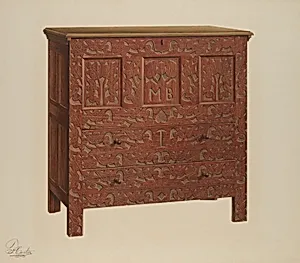
This vibrant rendering of a chest, created by artist Ferdinand Cartier around 1939, captures the details of an American furniture piece from the Index of American Design. Part of a landmark Works Progress Administration (WPA) during the Great Depression, Index employed artists to document everyday objects of American folk and decorative arts, preserving cultural heritage through precise, colorful illustrations. Cartier's work exemplifies this mission, transforming a functional chest—measuring about 3 feet 6 inches high, wide, and 19 inches deep—into a study of craftsmanship that highlights regional woodworking traditions. Executed in watercolor, colored pencil, and graphite on paperboard (45.6 x 51.9 cm), the piece showcases meticulous techniques to convey texture, grain, and subtle hues. The layered media allowed Cartier to render the chest's form with lifelike accuracy, from its sturdy proportions to any ornamental flourishes, making it a valuable record for scholars and enthusiasts. Housed in the National Gallery of Art's collection, this artwork underscores the Index's role in celebrating America's vernacular design, bridging art history with everyday life.
About the Artist
Ferdinand Cartier · 1892–1987
Ferdinand Cartier is an artist whose historical record remains limited. No confirmed birth or death dates have been established, and his national origin and training background are not documented in surviving sources, making it difficult to place him within any specific artistic tradition or school. Cartier's presence in museum collections, with close to fifty works attributed to him, points to a...