
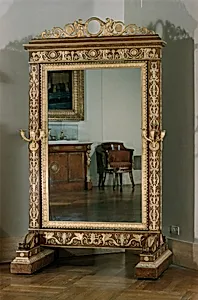
Cheval glass (psyché)
ca. 1810–14
Medium
Amboyna veneered on oak; gilt-bronze mounts; glass
Dimensions
Overall: 86 x 48 5/8 x 31 5/8 in. (218.4 x 123.5 x 80.3 cm)
Classification
Woodwork-Furniture
Culture
French, Paris
Department
European Sculpture and Decorative Arts
Museum
Metropolitan Museum of Art, New York, NY
Credit
Fletcher Fund, 1924
Accession Number
24.230
Rights
Public Domain
Art Historical Context
This elegant cheval glass, also known as a psyché, was created around 1810–1814 by the celebrated Parisian cabinetmaker François-Honoré-Georges Jacob-Desmalter. Produced during the Napoleonic Empire, such full-length tilting mirrors were prized furnishings in fashionable French interiors, reflecting the era’s taste for grandeur and personal refinement. Jacob-Desmalter, favored by the imperial court, specialized in luxurious neoclassical furniture that blended clean lines with opulent details. Crafted from amboyna veneer over oak and fitted with gilt-bronze mounts and a large pivoting glass, the piece stands nearly seven feet tall. The exotic amboyna wood, imported from Southeast Asia, and the shimmering metal accents highlight the technical mastery and international reach of Parisian workshops at the time. Its practical tilting design allowed users to admire their entire reflection, combining utility with artistic display. Today in the Metropolitan Museum of Art’s collection, this psyché offers a window into early nineteenth-century French decorative arts and the refined domestic world of the Empire period.