
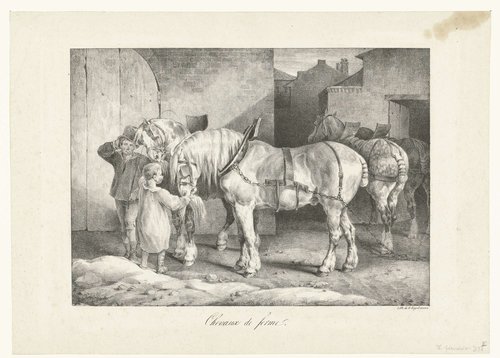
Chevaux de ferme
Medium
lithography
Dimensions
357; 192; 256; 267
Rights
Public Domain
About this artwork
collector's mark: Lugt 2228
Art Historical Context
**Chevaux de ferme (Farm Horses)** *Théodore Géricault,1823, Lithography 192 × 267 mm* Théodore Géricault a leading figure of French Romanticism, captured the raw power and vitality of horses throughout his career, from monumental canvases like *The Raft of the Medusa* intimate prints. Created in 1823—just a year before his untimely death at age 32—*Chevaux de ferme* his fascination with equine subjects, likely inspired by the working horses of rural France. This lithography, a revolutionary printmaking technique Géricault helped pioneer in the early 19th century, allowed artists to draw directly on stone with greasy crayon, producing rich, painterly tones and fluid lines that mimic oil painting. The modest dimensions of this work (192 × 267 mm) invite close viewing, revealing Géricault's masterful rendering of muscle, movement, and texture—hallmarks of his dynamic style. Lithography's affordability democratized art, making such vivid depictions accessible beyond elite patrons. Bearing the collector's mark Lugt 2228, this print traces its provenance to a distinguished 19th- or early 20th-century collector, underscoring its enduring appeal. In the Romantic era's embrace of nature's untamed energy, *Chevaux de ferme* evokes the nobility of everyday labor, blending realism with emotional intensity—a testament to Géricault's innovative spirit.
About the Artist
Théodore Géricault · 1791–1824
Théodore Géricault (1791-1824) stands as one of the most influential pioneers of French Romanticism, despite a career tragically cut short at age thirty-two. Born in Rouen on September 26, 1791, into a wealthy family, Géricault's brief but intense artistic life transformed the trajectory of nineteenth-century European painting. Géricault began his formal training in 1808 under Carle Vernet, maste...