
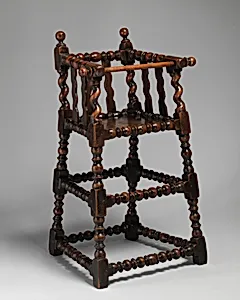
Child's high chair
Unknown Artist
ca. 1660
Medium
Walnut
Dimensions
Overall: 34 1/2 × 20 × 17 1/2 in. (87.6 × 50.8 × 44.5 cm)
Classification
Woodwork-Furniture
Culture
British
Department
European Sculpture and Decorative Arts
Museum
Metropolitan Museum of Art, New York, NY
Credit
Gift of Irwin Untermyer, 1964
Accession Number
64.101.899
Rights
Public Domain
Art Historical Context
Step into the world of 17th-century domestic life with this charming child's high chair, crafted around 1660 from rich walnut wood. Standing at 34½ inches tall, this sturdy piece—now housed in the Metropolitan Museum of's European Sculpture and Decor Arts department—was designed to elevate infants securely during mealtimes, a practical innovation for affluent households of the Restoration era. Donated by Irwin Untermyer in 4, it exemplifies the's furniture craftsmanship, with its compact form (20 × 17½ inches at the base) tailored for little ones. Walnut, prized for its durability, fine grain, and warm tone, became a favored material in English woodworking after the 1660s, as native oak gave way to imported hardwoods. This high chair likely features traditional joinery techniques like mortise-and-tenon construction and turned elements, showcasing the skill of an unknown artisan in a time when furniture was both functional and a status symbol. Such pieces were rare even then, reserved for the upper classes amid England's post-Civil War recovery. Today, this survivor offers a poignant glimpse into family life 350 years ago, reminding us how early modern parents invested in their children's comfort. Its simple elegance bridges utility and heirloom quality, inviting us to appreciate the everyday artistry of the past.