
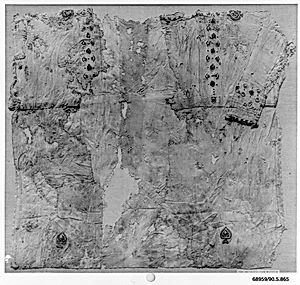
Child's Tunic
Unknown Artist
5th–6th century
Medium
Linen, wool
Dimensions
Max. H. 26 1/16 in. (66.2 cm) Max. W. 27 15/16 in. (71 cm)
Classification
Textiles
Department
Islamic Art
Museum
Metropolitan Museum of Art, New York, NY
Credit
Gift of George F. Baker, 1890
Accession Number
90.5.865
Rights
Public Domain
Art Historical Context
This delicate Child's Tunic, crafted from linen and wool in the 5th–6th, offers a poignant glimpse into daily life during Late Antiquity. Measuring about 26 inches tall and 28 inches wide, it was designed for a young child, likely in Egypt or the surrounding Mediterranean region, where such garments were everyday wear. As a textile classified in the Metropolitan Museum of Art's Islamic Art, it bridges the late Roman, Coptic Christian, and early Islamic worlds, the continuity of craftsmanship in a time of cultural transition. The tunic's materials—lightweight linen for the body and durable wool for accents—highlight advanced weaving techniques of the era. Linen provided breathability in hot climates, while wool added warmth and color vibrancy, often dyed with natural pigments. These textiles were labor-intensive, woven on simple looms, and sometimes decorated with patterns symbolizing protection or status, though this example's simplicity speaks to practical childrenswear. Its presence in the Met's collection, a gift from George F. Baker in 1890, underscores the enduring fascination with ancient fabrics. For visitors, this tunic humanizes history, revealing how families dressed and cared for their little ones amid empires rising and falling, preserving threads of the past in every stitch.