
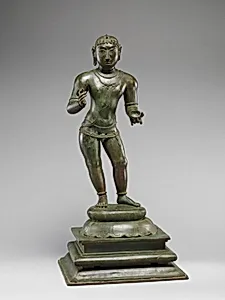
Child Saint Sambandar
Unknown Artist
late 11th century
Medium
Copper alloy
Dimensions
H. 29 3/8 in. (74.6 cm); W. 14 5/8 in. (37.1 cm); D. (rectangular base) 12 5/8 in. (32.1 cm)
Classification
Sculpture
Culture & Period
India, Tamil Nadu · Chola period (880–1279)
Department
Asian Art
Museum
Metropolitan Museum of Art, New York, NY
Credit
Purchase, Lila Acheson Wallace and Doris Wiener Gifts, 2010
Accession Number
2010.230
Rights
Public Domain
Tags
Art Historical Context
Behold the striking bronze sculpture of *Child Saint Sambandar*, late 11th-century masterpiece India's Chola period (880–1279), in Tamil Nadu. Standing nearly 30 inches tall, this copper alloy figure captures the youthful devotee of Shiva—one of the revered Nayanar saints—as a divine child prodigy. Sambandar, who composed profound hymns to the god as a toddler, embodies the Chola era's deep Shaivite piety, when rulers patronized grand temples adorned with such portable processional images. Chola bronzes like this exemplify technical brilliance through the lost-wax casting method, yielding slender, elegant forms with intricate details: flowing garments, jewelry, and a serene expression radiating spiritual ecstasy. The rectangular base grounds the figure's dynamic contrapposto pose, highlighting the period's mastery of proportion and motion, often seen in temple rituals where sculptures were carried in vibrant festivals. Acquired in 2010 by The Metropolitan Museum of Art, this rare depiction celebrates childhood sanctity and artistic devotion, inviting visitors to marvel at Chola South India's golden age of sculpture.