
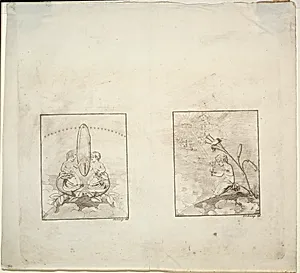
Child with Rosebud
Medium
Etching on ivory wove paper
Dimensions
Image: 10 × 8 cm (3 15/16 × 3 3/16 in.); Plate: 24.5 × 25 cm (9 11/16 × 9 7/8 in.); Sheet: 26 × 28 cm (10 1/4 × 11 1/16 in.)
Classification
etching
Department
Prints and Drawings
Museum
Art Institute of Chicago
Accession Number
117789
Rights
Public Domain
Art Historical Context
**Child with Rosebud** is a delicate etching by Phillip Otto Runge, a German Romantic artist active in the early 19 century. Runge (1777–1810), often celebrated alongside Caspar David Friedrich, infused his works with spiritual symbolism, drawing inspiration from nature, childhood innocence, and Goethe's color theory. Though undated, this intimate print likely dates to his mature period around 1800–1810, when he explored themes of purity and transience through tender child figures amid floral motifs. Housed in the Art Institute of Chicago's Prints and Drawings department, it exemplifies Runge's vision of art as a bridge between the earthly and divine. Crafted as an etching on fine ivory wove paper, the work showcases Runge's mastery of intaglio techniques. Etching allowed him to incise precise, expressive lines into a metal plate, which acid then etches to hold ink—yielding rich tonal contrasts ideal for subtle textures like a child's soft features or the velvety petals of a rosebud. The modest image size (10 × 8 cm) contrasts with the larger plate and sheet, highlighting the print's reproducibility while preserving intricate detail on high-quality paper that enhances luminosity and finesse. This piece captures Romanticism's reverence for innocence, with the rosebud evoking fleeting beauty and renewal—hallmarks of Runge's symbolic lexicon. A gem for print enthusiasts, it invites visitors to ponder how such small-scale works carried profound emotional weight in an era of artistic innovation.