
Childhood
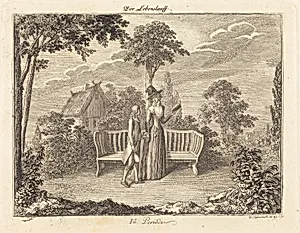
Medium
etching
Classification
Department
CG-E
Museum
National Gallery of Art, Washington, D.C.
Credit
Anonymous gift in memory of Charles B. Hoyt
Accession Number
1950.2.20
Rights
Public Domain
Art Historical Context
Daniel Nikolaus Chodowie's *Childhood* (1793) is a delicate etching that captures the innocence and everyday joys of youth during the late Enlightenment era. Chodwiecki, a prolific Polish-German artist and director of the Berlin Academy Arts, was renowned for his intricate prints depicting moralistic scenes from 18th-century European life. His works often blended Rococo elegance with emerging Neoclassical clarity, offering gentle social commentary on family, virtue, and human emotions. As an etching, this print showcases Chodwiecki's mastery of the medium: lines incised into a metal plate with acid create fine, expressive details, allowing for mass production while retaining artistic nuance. Etchings like this were popular for illustrating books and moral tales, making art accessible beyond elite patrons. The title evokes Rousseau's influential ideas on natural child-rearing, reflecting a cultural shift toward valuing childhood as a distinct, formative stage. Housed in the National Gallery of Art's CG-E department through an anonymous gift in memory of Charles B. Hoyt, *Childhood* invites visitors to ponder timeless themes of growth and tenderness. Chodwiecki produced over 2,000 prints in his lifetime, cementing his legacy as a chronicler of bourgeois life.
About the Artist
Daniel Nikolaus Chodowiecki · 1726–1801
Daniel Nikolaus Chodowiecki (1726–1801) was a German painter and printmaker of Polish-Huguenot descent who became the most celebrated graphic artist in 18th-century Germany. Born in Danzig (now Gdańsk), he created approximately 2,000 etchings that serve as an invaluable visual record of German bourgeois life during the Enlightenment. Largely self-taught, Chodowiecki moved to Berlin in 1743 and ach...