
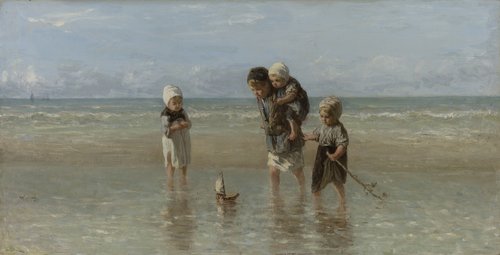
Children of the Sea
1872
Medium
oil on canvas
Dimensions
91; 49; 48.5; 93.5
Rights
Public Domain
About this artwork
olieverf op doek
Art Historical Context
Jozef Israëls, a prominent Dutch artist of the Hague School, created *Children of the Sea* in 1872 as a sensitive portrayal of everyday coastal life. Working in the realist tradition, Israëls often turned his attention to the quiet struggles and simple joys of fishing communities, influenced by both Dutch Golden Age traditions and contemporary French naturalism. The modest scale of this oil on canvas—roughly 48 by 93 centimeters—invites close viewing, allowing the textured brushwork to convey the movement of waves and the vulnerability of young figures against the vast sea. The painting reflects broader 19th-century interest in social themes, highlighting the relationship between humans and nature during a period of rapid industrialization. By focusing on children rather than dramatic shipwrecks or heroic sailors, Israëls emphasizes innocence, resilience, and the generational ties that sustained fishing villages along the Dutch coast. The Rijksmuseum’s collection places the work within a rich narrative of national identity and artistic renewal. Oil paint’s versatility enabled Israëls to blend luminous skies with somber tones, creating an emotional depth that resonated with viewers of his time. Today, the piece continues to offer museum visitors a window into 19th-century Dutch coastal culture and the enduring power of empathetic realism.
About the Artist
Jozef Israëls · 1824–1911
Israëls was born in Groningen to poor Jewish parents. He trained as an artist in Groningen and Amsterdam, and between 1845 and 1855, he expanded his training by travelling to Paris, Dusseldorf, and the artist's colony at Oosterbeek. However, the most influential locations he visited were the Dutch seaside towns of Zandvoort and Katwijk, were he adopted genre painting as a means of documenting the ...