
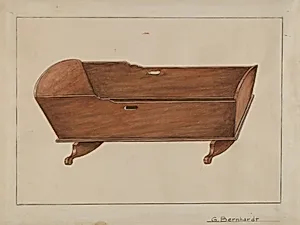
Child's Cradle
c. 1936
Medium
watercolor, colored pencil, graphite, and some heightening on paper
Dimensions
overall: 22.9 x 30.5 cm (9 x 12 in.) Original IAD Object: 3'4" x 2'2"
Classification
Index of American Design
Department
CG-W
Museum
National Gallery of Art, Washington, D.C.
Credit
Index of American Design
Accession Number
1943.8.4900
Rights
Public Domain
Art Historical Context
Gerald Bernhardt's *Child's Cradle*c. 1936) is a meticulous rendering from the Index of American Design, a WPA Federal Art Project that celebrated everyday American craftsmanship during the Great Depression. Created watercolor, colored pencil,, and subtle heightening on paper (22.9 x 30.5 cm), this captures the intricate details of a folk cradle originally measuring 3'4" x 2'2". Bernhardt's technique—layering translucent watercolors for depth, precise pencil lines for form, and highlights for texture—brings the wooden object's curves, joinery, and ornamentation to life, making it a faithful study rather than a mere sketch. The Index of American Design (1935–1942) employed artists like Bernhardt to document vanishing regional crafts, preserving cultural heritage amid economic hardship. Cradles like this one embodied domestic ingenuity, often handmade by local artisans with regional motifs reflecting community values of family and protection. Housed in the National Gallery of Art's collection, this piece underscores the project's role in elevating folk art to national treasure status, reminding us how ordinary objects tell profound stories of American life.