
Child's Lace Cap
1935/1942
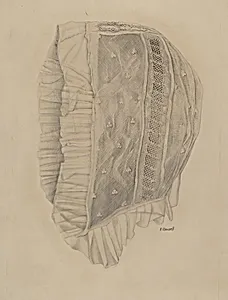
Medium
watercolor and graphite on paperboard
Dimensions
overall: 35.5 x 28.2 cm (14 x 11 1/8 in.)
Classification
Index of American Design
Department
CG-W
Museum
National Gallery of Art, Washington, D.C.
Credit
Index of American Design
Accession Number
1943.8.3181
Rights
Public Domain
Art Historical Context
Behold the delicate *Child's Lace Cap*, meticulous 1935/1942 watercolor and graphite rendering by Raymond Manupelli, measuring 35.5 x 28.2 cm. Housed in the National Gallery of Art's Index of Design, this work captures the intricate patterns and airy elegance of a traditional American lace cap for children, evoking the craftsmanship of early American folk traditions. Created as part of the Federal Art under the Works Progress Administration (WPA) during the Great Depression, Index of American Design employed artists like Manupelli to document everyday objects, preserving the nation's cultural heritage through thousands of precise, colorful studies. Spanning 1935 to 1942, this initiative celebrated regional crafts, from quilts to ceramics, highlighting America's diverse design legacy amid economic hardship. Manupelli's technique shines in the subtle layering of watercolor for translucent lace textures and graphite for sharp edges, rendering the cap's floral motifs and scalloped edges with photographic fidelity. This artwork not only showcases technical virtuosity but also underscores the cultural value of heirloom items, reminding us of the tender, handmade touches in children's attire from America's past. A charming window into bygone domestic artistry!
About the Artist
Raymond Manupelli · 1855–present
Raymond Manupelli is an artist about whom detailed biographical and historical documentation is limited. No confirmed dates of birth or death have been established in major art-historical reference sources, and his nationality remains unverified. The works associated with his name suggest activity as a practitioner in one or more visual media, but the specifics of his training, principal influence...