
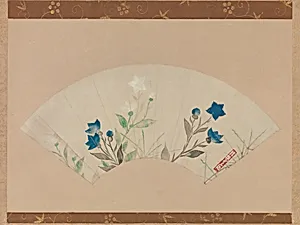
Chinese Bellflowers
Medium
Folding fan remounted as a hanging scroll; ink and color on paper
Dimensions
Image: 15 1/4 × 22 3/8 in. (38.7 × 56.8 cm) Overall with mounting: 51 1/8 × 27 3/4 in. (129.9 × 70.5 cm) Overall with knobs: 51 1/8 × 29 3/4 in. (129.9 × 75.6 cm)
Classification
Paintings
Culture & Period
Japan · Edo period (1615–1868)
Department
Asian Art
Museum
Metropolitan Museum of Art, New York, NY
Credit
The Harry G. C. Packard Collection of Asian Art, Gift of Harry G. C. Packard, and Purchase, Fletcher, Rogers, Harris Brisbane Dick, and Louis V. Bell Funds, Joseph Pulitzer Bequest, and The Annenberg Fund Inc. Gift, 1975
Accession Number
1975.268.64
Rights
Public Domain
Tags
Art Historical Context
Ogata Kōrin's *Chinese Bellflowers* is a captivating example of Edo-period (1615–1868) Japanese art from the Rinpa school, movement celebrated for its bold, decorative style inspired by nature. Kōrin (1658–1716), a master of rhythmic compositions and vibrant palettes, transformed everyday motifs like these delicate bellflowers into poetic emblems of beauty and transience. Created during Japan's prosperous Tokugawa era when urban culture flourished among merchants and samurai, the painting reflects the era's fascination with elegant, stylized flora, often evoking the fleeting elegance of the seasons. Originally painted on a folding fan—a popular, portable format for intimate appreciation—the work was later remounted as a hanging scroll, allowing it to grace formal spaces like tea rooms or alcoves. This ink and color on paper medium showcases Rinpa techniques, such as asymmetrical arrangements and mineral pigments for luminous depth, creating a sense of rhythmic flow amid the blooms. The fan's transformation highlights how Japanese art adapted functional objects into timeless treasures. Displayed in the Metropolitan Museum of Art's Asian Art, this piece from The Harry G. C. Packard Collection invites visitors to ponder the harmony of art and nature in Edo Japan, where even a simple flower could bloom into profound cultural resonance.
About the Artist
Ogata Kōrin · 1658–1716
Noted as one of the most important Japanese artists of the 17th century; known for paintings of irises and other subjects. He was regarded, along with Sotatsu, as one of the masters of the Sotatsu-Koetsu school of decorative painting, including painted screens and textile designs. He was descended from a samurai who had served under the Ashikaga rulers.