
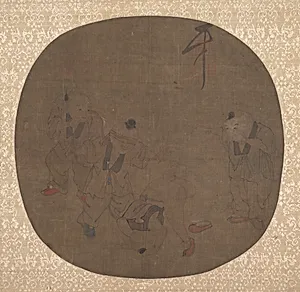
Chinese Children at Play
Medium
Fan mounted as an album leaf; ink and color on silk
Dimensions
8 5/16 x 9 1/2 in. (21.1 x 24.1 cm)
Classification
Paintings
Culture & Period
China · Ming (1368–1644) or Qing dynasty (1644–1911)
Department
Asian Art
Museum
Metropolitan Museum of Art, New York, NY
Credit
From the Collection of A. W. Bahr, Purchase, Fletcher Fund, 1947
Accession Number
47.18.82
Rights
Public Domain
Tags
Art Historical Context
"Chinese Children at Play" a joyful moment of childhood in traditional China, depicting boys engaged in lively games. Attributed to the legendary Emperor Huizongrenowned Song dynasty artist and calligrapher (r. 1100–1126)—though by an unidentified hand, this intimate painting dates to the Ming (1368–1644) or Qing (1644–1911) dynasty Such attributions were common in later eras, evoking the emperor's refined style of meticulous ink and color work on silk. Originally a fan, now elegantly mounted as an album leaf (8 5/16 x 9 1/2 in.), the medium highlights the artistry of portable, personal objects prized by China's literati elite. Fans served both practical and aesthetic purposes, unfolding scenes of daily life amid scholarly pursuits. The delicate silk surface allows vibrant colors and fluid ink lines to convey motion and innocence, reflecting Confucian ideals of harmonious play and moral education through leisure. Acquired from collector A.W. Bahr and now in the Metropolitan Museum of Art's Asian Art collection (Purchase, Fletcher Fund, 1947), this work offers a rare glimpse into vernacular joys, contrasting grand imperial themes. It reminds us how Chinese painting celebrated the simple pleasures of youth, bridging elite artistry with universal human delight.