
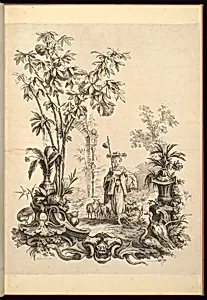
Chinoiserie with Figure in a Landscape
1729-1760
Medium
Bound print
Classification
Bound print
Department
Smithsonian Collection
Museum
Smithsonian American Art Museum
Credit
Purchased for the Museum by the Advisory Council
Accession Number
1921-6-203-3
Rights
Public Domain
About this artwork
Research in Progress
Art Historical Context
Gabriel Huquier's *Chinoiserie with Figure in a Landscape*, created between 1729 and 1760, exemplifies the enchanting Rococo fascination with the exotic East. As a French engraver and printmaker (1695–1772), Huquier was renowned for his delicate reproductions of fashionable designs, often drawing from contemporaries like Antoine Watteau. This bound print—likely part of an album or volume—captures the whimsical chinoiserie style, a European interpretation of Chinese motifs featuring pagodas, flowing landscapes, and elegant figures amid lush scenery. Chinoiserie flourished in 18th-century France, adorning everything from furniture to wallpaper as a symbol of refined luxury and global curiosity during the Enlightenment. Huquier's etching technique allowed for intricate details and subtle tonal effects, making these prints affordable vehicles for disseminating high-style decoration to a wider audience. The medium's portability and reproducibility democratized elite tastes, influencing interiors across Europe. Acquired for the Smithsonian American Art Museum through the Advisory Council, this work highlights the cross-cultural exchanges that shaped artistic innovation. Though research continues, it invites visitors to ponder how imagined "Chinas" inspired real-world creativity in the opulent age of Versailles.