
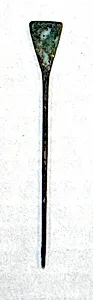
Chisel or tupu (pin)
Unknown Artist
200 BCE–850 CE
Medium
Copper
Dimensions
L. 3 9/16 in. (9 cm)
Classification
Metal-Implements
Culture
Ciénaga or La Aguada
Department
Arts of Africa, Oceania, and the Americas
Museum
Metropolitan Museum of Art, New York, NY
Credit
Gift of Mr. and Mrs. Nathan Cummings, 1964
Accession Number
64.228.619
Rights
Public Domain
Art Historical Context
This elegant copper chisel or *tupu* (pin) hails from the Ciénaga or La Aguada cultures of northwestern Argentina, thriving between 200 BCE and 850 CE. These pre-Columbian societies, centered in regions like Catamarca, marked a pivotal era in South American metallurgy, transitioning from stone tools to crafted metals. Measuring just 3 9/16 inches (9 cm) long, this implement exemplifies the ingenuity of early Andean peoples, who valued copper for its workability and symbolic prestige. Forged from pure copper, the object likely served dual purposes: as a practical chisel for woodworking or stone carving, or as a *tupu*—a decorative pin securing shawls or hair, common in Andean attire. Its simple yet refined form highlights advanced hammering and annealing techniques, enabling durability without complex alloys. Such artifacts reveal how metalwork bridged utility and status, reflecting communal craftsmanship in ritual and daily life. A generous gift to the Metropolitan Museum of Art from Mr. and Mrs. Nathan Cummings in 1964, this piece invites us to ponder the sophisticated technologies of ancient Americas, long before European contact. (198 words)