
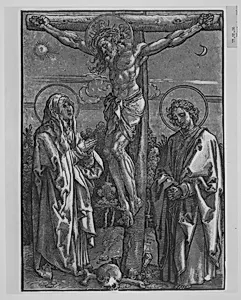
Christ on the Cross flanked by the Virgin and Saint John
ca 1530–1540
Medium
Chiaroscuro woodcut with tone block in green
Dimensions
Sheet: 11 3/4 × 8 1/4 in. (29.8 × 21 cm)
Classification
Prints
Department
Drawings and Prints
Museum
Metropolitan Museum of Art, New York, NY
Credit
Purchase, Joseph Pulitzer Bequest, 1917
Accession Number
17.50.36
Rights
Public Domain
Tags
Art Historical Context
This poignant chiaroscuro woodcut titled *Christ on the Cross flanked by Virgin and Saint John*,ails from the Dür-School around 1530–1540, reflecting the enduring influence of Albrecht Dürer, the master of Northern Renaissance printmaking. Created shortly after Dürer's death in 8, it captures the dramatic Crucifixion scene: Christ on the cross, mourned by his mother, the Virgin Mary, and John the Evangelist. Such devotional images were central to 16th-century European piety, inviting viewers to contemplate Christ's sacrifice amid the religious fervor of the Reformation era. The artwork's medium—a chiaroscuro woodcut with a tone block in green—demonstrates innovative print techniques. Chiaroscuro, meaning "light-dark" in Italian, employs multiple woodblocks: one for bold outlines and another for tonal shading, creating a painterly illusion of depth and volume. The unusual green tone block adds a subtle, atmospheric hue, evoking somber mood and natural light filtering through a sacred space. Measuring 11 3/4 × 8 1/4 inches, this intimate sheet was designed for personal devotion or collection. Acquired by The Metropolitan Museum of Art in 1917 through the Joseph Pulitzer Bequest, this print exemplifies how Dürer's school advanced woodcut artistry, bridging painting and reproduction to make profound religious narratives accessible to a wider audience. Its technical finesse and emotional intensity continue to resonate today.