
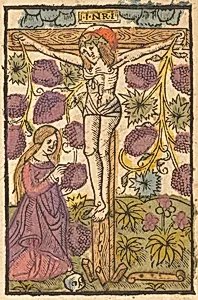
Christ on the Cross with a Grape Vine
c. 1490/1500
Medium
woodcut with hand-coloring on laid paper
Dimensions
sheet: 11.5 × 8.5 cm (4 1/2 × 3 3/8 in.)
Classification
Department
CG-E
Museum
National Gallery of Art, Washington, D.C.
Credit
Rosenwald Collection
Accession Number
1943.3.803
Rights
Public Domain
Art Historical Context
This intimate woodcut from around 1490–1500 captures Christ on the Cross entwined with a grape vine, a powerful symbol linking the crucifixion to the Eucharist and the promise of redemption. Created by an anonymous French or Netherlandish artist, the print measures just 11.5 by 8.5 centimeters, suggesting it was designed for personal devotion rather than public display. The woodcut technique, one of the earliest forms of printmaking, allowed religious images like this to reach a broader audience during the late Middle Ages, when literacy was limited and visual storytelling played a central role in faith. The hand-coloring applied after printing adds warmth and individuality to each impression, a common practice that bridged the gap between mass-produced prints and the luminous quality of illuminated manuscripts. In this work, the vine curling around the cross subtly evokes Christ’s words in the Gospel of John—“I am the vine, you are the branches”—emphasizing themes of spiritual nourishment and sacrifice that resonated deeply with fifteenth-century viewers. Housed in the National Gallery of Art’s Rosenwald Collection, this small devotional print reflects the growing accessibility of sacred imagery on the eve of the Reformation, when affordable religious prints helped shape personal piety across Europe.