
Christie's Auction Room, Pall Mall
ca. 1808–10
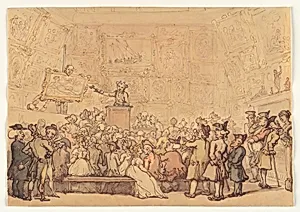
Medium
Pen and brown ink and watercolor over traces of graphite on cream paper.
Dimensions
200 x 283 mm.
Classification
Drawings
Department
Robert Lehman Collection
Museum
Metropolitan Museum of Art, New York, NY
Credit
Robert Lehman Collection, 1975
Accession Number
1975.1.893
Rights
Public Domain
Tags
Art Historical Context
Step into the lively chaos of Thomas Rowlandson's *Christie's Auction Room, Mall* (ca. 1808–10), a vibrant watercolor that captures the thrill of one of London's premier auction houses during the Regency era. Rowlandson, a master caricaturist renowned for his satirical depictions of British society, sketches a bustling interior packed with men and women eagerly bidding on treasures. The scene buzzes with exaggerated expressions and dynamic poses, poking fun at the social spectacle where fortunes changed hands amid art, antiques, and curiosities. Created with pen and brown ink over faint graphite traces, then enlivened by watercolor washes on cream paper (200 x 283 mm), this drawing exemplifies Rowlandson's fluid, economical technique. His loose lines and subtle color build energy and humor, making the intimate format feel expansive—like peeking through a keyhole at high society. Christie's, established in 1766 on Pall Mall, was a cultural hub where the elite mingled, and Rowlandson's work offers a witty snapshot of early 19th-century commerce and class. Housed in the Metropolitan Museum of Art's Robert Lehman Collection, this piece highlights Rowlandson's enduring appeal: blending sharp observation with playful critique, it invites us to chuckle at human folly across centuries.
About the Artist
Thomas Rowlandson · 1756–1827
Thomas Rowlandson (1757–1827) was an English artist and caricaturist whose satirical watercolors and prints captured the social life of Georgian Britain with unparalleled wit and technical mastery. Alongside James Gillray, he is recognized as one of the greatest British graphic artists, and his distinctive flowing line and keen observations have made his work integral to understanding late 18th an...