
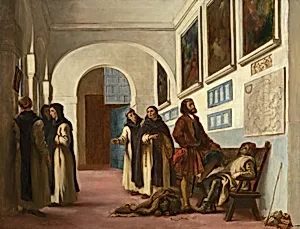
Christopher Columbus and His Son at La Rábida
1838
Medium
oil on canvas
Dimensions
overall: 90.3 x 118 cm (35 9/16 x 46 7/16 in.) framed: 118.4 x 146.7 cm (46 5/8 x 57 3/4 in.)
Classification
Painting
Department
CF
Museum
National Gallery of Art, Washington, D.C.
Credit
Chester Dale Collection
Accession Number
1963.10.127
Rights
Public Domain
Art Historical Context
In this oil painting, a quiet corridor lined with arched doorways and pale walls opens onto a scene of encounter. Several figures in brown and white monastic robes stand clustered near the center, their gestures and turned heads suggesting conversation. To the right, a man in a crimson doublet and boots sits on a wooden, while a boy in simpler clothing rests against him, eyes closed. Paintings and a large map hang on the wall behind them, and a bundle of discarded garments lies on the pink-tiled floor. Eugène Delacroix painted Christopher Columbus and His Son at La Rábida in 1838. A leading figure of French Romanticism, Delacroix often chose dramatic historical subjects and rendered them with rich color and fluid brushwork. Here the restrained setting and attentive poses invite viewers to consider a pivotal moment of seeking support and shelter before a great voyage. The National Gallery of Art’s canvas captures the human scale of that story through careful attention to costume, architecture, and expression rather than spectacle.
About the Artist
Eugène Delacroix · 1798–1863
Eugène Delacroix (1798–1863) stands as the defining figure of French Romanticism and a pivotal bridge to modernism. Born in Charenton-Saint-Maurice near Paris, he came from distinguished lineage—his mother descended from the prestigious Oeben-Riesener furniture dynasty, while persistent speculation suggested the statesman Talleyrand may have been his biological father, a theory supported by physic...