
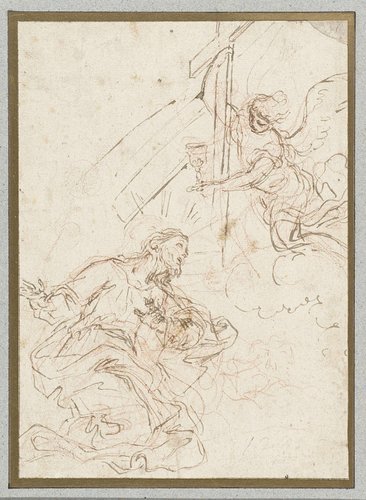
Christus in de Hof van Gethsemane
1676 - 1724
Medium
pen
Dimensions
246; 177
Rights
Public Domain
About this artwork
ondertekening in rood krijt, pen in bruin
Art Historical Context
**Christus in de Hof van Gethsem** by Benedetto Luti (1666–1724) captures a poignant moment from the New Testament: Jesus in the Garden of Gsemane on the eve of his betrayal and crucifixion. This intimate drawing, measuring 246 × 177 mm, reflectsuti's mastery as a leading Italian Baroque artist active in late 17th- and early 18th-century Rome Trained under Carlo Maratti, Luti blended classical elegance with emotional depth, often drawing on biblical themes to evoke spiritual contemplation for devout patrons like cardinals and nobility. The work showcases Luti's skillful draftsmanship through a red chalk underdrawing—visible as subtle outlines—enhanced by precise brown ink pen lines. This layered technique, common in Baroque preparatory studies, allowed artists to refine forms with fluid hatching and contouring, building volume and light on paper. Such drawings were prized not just as sketches but as independent artworks, bridging studio practice and finished paintings. In the cultural landscape of Counter-Reformation Europe, scenes like this reinforced Catholic devotion, inviting viewers to meditate on Christ's agony. Luti's version, with its restrained yet expressive lines, exemplifies how Baroque draftsmen humanized sacred narratives, making divine suffering relatable. A gem for drawing enthusiasts, it highlights the era's reverence for the "disegno" (design) as the soul of art.
About the Artist
Benedetto Luti · 1666–1724
Comment on works: Religious