
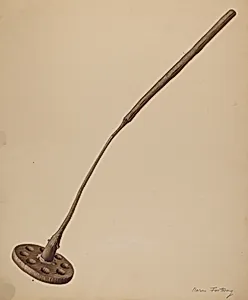
Churn
c. 1939
Medium
watercolor, graphite, and colored pencil on paperboard
Dimensions
overall: 45.7 x 38.3 cm (18 x 15 1/16 in.)
Classification
Index of American Design
Department
CG-W
Museum
National Gallery of Art, Washington, D.C.
Credit
Index of American Design
Accession Number
1943.8.9616
Rights
Public Domain
Art Historical Context
Behold the humble yet elegant *Churn*, a captivating watercolor, graphite, and colored pencil rendering by Aaron Fastovsky, created around 1939. Measuring 45.7 x 38.3 cm, this work on paperboard meticulously captures a traditional butter churn—a quintessential piece of American folk craftsmanship. Fastovsky's precise hand brings to life the churn's wooden form, staves, and lid, transforming an everyday tool into a study of form and function. This artwork is a gem from the Index of American Design, a ambitious Federal Art Project under the Works Progress Administration (WPA) from 1935 to 1942. During the Great Depression, over 200 artists documented thousands of American decorative arts objects through hyper-realistic illustrations, preserving cultural heritage at risk of being lost. Fastovsky's contribution exemplifies the Index's mission to celebrate vernacular design, elevating utilitarian items like the churn—once central to rural households—as symbols of ingenuity and tradition. The mixed-media technique shines here: watercolor adds luminous color and subtle gradients, graphite provides sharp lines for intricate details, and colored pencil enhances texture, mimicking wood grain with remarkable fidelity. Housed in the National Gallery of Art's collection, *Churn* invites us to appreciate how ordinary objects embody America's inventive spirit and enduring folk artistry.
About the Artist
Aaron Fastovsky · 1899–1979
Aaron Fastovsky is an artist whose biographical record is not well preserved. No birth or death dates have been confirmed, and his nationality and artistic background remain unestablished in available sources, leaving the circumstances of his training and career largely unknown. Fastovsky's surviving works in museum collections — numbering close to fifty — suggest a dedicated practice. The scale ...