
Cigar Store Indian
1935/1942
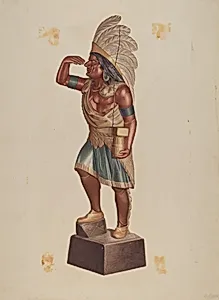
Medium
watercolor, colored pencil, and graphite on paper
Dimensions
overall: 53.9 x 38.4 cm (21 1/4 x 15 1/8 in.)
Classification
Index of American Design
Department
CG-W
Museum
National Gallery of Art, Washington, D.C.
Credit
Index of American Design
Accession Number
1943.8.10067
Rights
Public Domain
Art Historical Context
Step into the vibrant world of American folk art with *Cigar Store Indian*1935/1942), a meticulous watercolor, colored pencil, and graphite rendering on paper by Albert Ryder This 21¼ × 15⅛-inch work captures the bold, life-sized wooden statues that once stood sentinel outside tobacco shops across the United States from the mid-19th to early 20th centuries. iconic figures, often carved by European immigrant artisans, depicted idealized Native American chiefs in feathered headdresses, holding tobacco products to evoke the myth of the peace pipe—blending commerce, cultural stereotype, and craftsmanship into enduring roadside symbols. Created as part of the Index of American Design—a WPA Federal Art Project from 1935 to 1942—Ryder's piece exemplifies the program's mission to document and celebrate everyday American decorative arts during the Great Depression. Artists like Ryder produced thousands of such detailed index cards, preserving vanishing folk traditions through precise, colorful studies that highlighted regional styles and materials. The mixed-media technique shines here: Ryder's fluid watercolors lend a luminous quality to the figure's vibrant attire, while colored pencil and graphite add sharp contours and textures, mimicking the original wood carvings' grain and patina. Housed in the National Gallery of Art, this artwork invites us to reflect on how commercial signage became folk art, bridging America's multicultural past with its creative legacy.
About the Artist
Albert Ryder · 1911–2001
Albert Ryder is an artist for whom biographical documentation is limited. No birth or death dates have been confirmed in major reference sources, and his nationality and training are not established in available records. His name is likely distinct from that of Albert Pinkham Ryder (1847–1917), the celebrated American symbolist painter, and should not be conflated with that better-documented figu...