
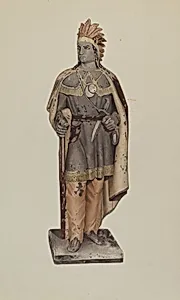
Cigar Store Indian
1935/1942
Medium
watercolor, colored pencil, and graphite on paper
Dimensions
overall: 43 x 25.9 cm (16 15/16 x 10 3/16 in.)
Classification
Index of American Design
Department
CG-W
Museum
National Gallery of Art, Washington, D.C.
Credit
Index of American Design
Accession Number
1943.8.10108
Rights
Public Domain
Art Historical Context
This vibrant watercolor rendering, titled *Cigar Indian*, captures a quintessential piece of American folk art from early 20th century Created between 1935 and 1942 by an anonymous American artist, it depicts a wooden trade figure typically used as signage outside cigar shops. These boldly carved statues, often showing Native American chiefs in feathered headdresses holding tobacco products, became urban landmarks in the United States during the 19th and early 20th centuries, commercial advertising with popular imagery of Indigenous peoples. As part of the Index of American Design—a Federal Art Project initiative during the Great Depression—this work documents vanishing traditions of American craftsmanship. Sponsored by the Works Progress Administration (WPA), the Index employed artists to produce precise, colorful studies of folk objects, preserving their cultural and aesthetic value for future generations. Housed in the National Gallery of Art, it highlights how everyday commercial art reflected national identity and economic life. The mixed media of watercolor, colored pencil, and graphite on paper (43 x 25.9 cm) allows for meticulous detail, from the figure's vibrant reds and golds to its carved wooden textures. This technique not only revives the statue's lively presence but underscores the Index's mission to celebrate democratic design, making folk heritage accessible and appreciated today.
About the Artist
American 20th Century · 1900–1999
"American 20th Century" is the designation used by major institutions such as the National Gallery of Art (NGA) for anonymous and unidentified artists active in the United States during the twentieth century. The artist's personal identity, early life, and training remain undocumented, reflecting the challenges of attribution for unattributed works from this era. No specific teachers, art schools,...