
Cinerary Urn, after the Antique
Nicolas Poussin, 17th–19th century
About this artwork
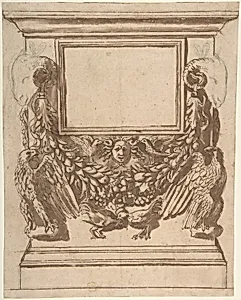
Nicolas Poussin, the preeminent French artist of the 17th century and a master of classical Baroque style, created this meticulous drawing titled *Cinerary Urn, after the Antique*. Dating to the 17th–19th century, it captures the intricate details of an ancient Roman funerary urn, reflecting Poussin's deep fascination with Greco-Roman antiquity. As a scholar-artist in Rome, Poussin frequently studied and copied classical artifacts to inform his paintings, blending archaeological precision with idealized beauty. This work exemplifies his role in the Renaissance revival of ancient forms, bridging antiquity and the emerging neoclassical taste. Executed in pen and brown ink with brush and brown wash over black chalk, the drawing showcases Poussin's virtuoso technique: delicate lines define ornate motifs like chickens, eagles, rams' heads, and expressive faces, evoking the urn's symbolic funerary purpose—eternal life, strength, and vigilance. Measuring 11 1/4 x 8 3/4 inches, its compact scale invites close inspection, revealing the subtle tonal washes that mimic stone's texture and depth. A gift to the Metropolitan Museum of Art from Cornelius Vanderbilt in 1880, this piece highlights the 19th-century American passion for European masterpieces. For visitors, it offers a window into how artists like Poussin preserved classical heritage, influencing everything from architecture to modern design.