
Circus Sideshow (Parade de cirque)
1887–88
Medium
Oil on canvas
Dimensions
39 1/4 x 59 in. (99.7 x 149.9 cm)
Classification
Paintings
Department
European Paintings
Museum
Metropolitan Museum of Art, New York, NY
Credit
Bequest of Stephen C. Clark, 1960
Accession Number
61.101.17
Rights
Public Domain
Tags
Art Historical Context
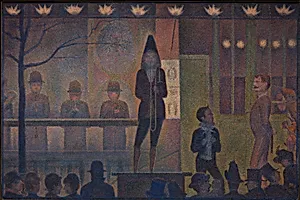
Georges Seurat’s *Circus Sideshow (Parade de cirque)* captures a lively evening scene outside a traveling circus in late-19th-century Paris. Painted in oil on canvas between 1887 and 1888, the nearly five-foot-wide work invites viewers to pause before a row of musicians and performers drawing in passersby. Seurat, a leading figure of Neo-Impressionism, used his signature pointillist technique—applying countless small dots of pure color that blend in the viewer’s eye—to create a shimmering, almost luminous surface that evokes both the artificial glow of gaslights and the quiet anticipation of the crowd. The subject reflects the era’s fascination with popular entertainment and modern urban life. Rather than focusing on the main ring acts, Seurat chose the preparatory “parade,” highlighting ordinary spectators, working musicians, and the subtle social rituals of the street. The balanced, almost architectural composition and cool palette underscore his interest in scientific theories of color and perception, transforming a fleeting moment into a carefully orchestrated visual harmony. Today in the Metropolitan Museum of Art, the painting remains a landmark example of how Seurat elevated everyday spectacle into enduring art. Its measured dots and measured rhythms reward slow looking, revealing new details with each glance.
About the Artist
Georges Seurat · 1859–1891
Georges Seurat (1859-1891) was the founder of Neo-Impressionism and the inventor of Pointillism, a revolutionary technique that transformed how artists understand and apply color. In a tragically brief career cut short at age 31, Seurat produced only seven monumental paintings, yet his systematic application of color theory fundamentally altered the direction of modern art. Born in Paris to a pro...