
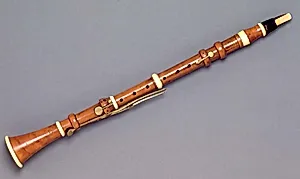
Clarinet in B-flat
ca. 1830–40
Medium
Boxwood, ebonite, ivory, brass
Dimensions
Total length : 660 mm. Bell diam.: 75 mm. Mouthpiece length: 91 mm. Barrel length: 56 mm. Upper body section: 231 mm. Middle body section: 123 mm. Lower body section: 146 mm. Bell: 121 mm.
Classification
Aerophone-Reed Vibrated-single reed cylindrical
Culture
American
Department
Musical Instruments
Museum
Metropolitan Museum of Art, New York, NY
Credit
The Crosby Brown Collection of Musical Instruments, 1889
Accession Number
89.4.899
Rights
Public Domain
Art Historical Context
This elegant Clarinet in B-flat, crafted by the American firm Graves & Company around 1830–40, exemplifies early 19th-century instrument making in the United States. Produced in Boston, where Graves was a prominent maker, it reflects a growing American craft tradition amid Europe's dominance in woodwind production. At a total length of 660 mm, with a bell diameter of 75 mm, this five-piece instrument (including barrel, body sections, and bell) was designed for the single-reed, cylindrical-bore mechanism that defines the clarinet's warm, versatile tone across its registers. Fashioned from boxwood for the body—prized for its acoustic resonance and workability—the clarinet features ebonite, ivory, and brass accents, highlighting the era's blend of natural and emerging materials. Ivory keys added precision and durability, while brass fittings ensured stability. As part of the Metropolitan Museum of Art's Crosby Brown Collection (acquired 1889), it offers a window into antebellum musical culture, when such instruments graced parlors, bands, and early orchestras, bridging classical influences with burgeoning American identity. Fun fact: Its key system likely follows the 13-key Mühlfeld model, an advancement that expanded chromatic possibilities, making complex music more accessible to amateur and professional players alike.