
Clasp Knife
Unknown Artist
18th century
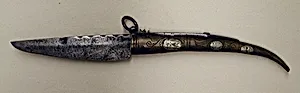
Medium
Brass, steel, silver
Dimensions
L. 8 in. (20.3 cm); W. 1 1/4 in. (3.2 cm); Wt. 1.7 oz. (48.2 g)
Classification
Knives
Culture
Spanish, Catalonia or Balearic Islands
Department
Arms and Armor
Museum
Metropolitan Museum of Art, New York, NY
Credit
Gift of Rutherfurd Stuyvesant, 1891
Accession Number
91.16.79
Rights
Public Domain
Art Historical Context
This elegant 18th-century clasp knife, hailing from Spain's Catalonia region or the Balearic Islands exemplifies the fine craftsmanship of Iberian metalwork. Measuring just 8 inches long when open, with a slender 1¼-inch width and lightweight 1.7-ounce build, it folds compactly for everyday carry—ideal as both a practical tool and a subtle weapon. Crafted from brass, steel, and silver, the knife showcases skilled joinery: a sharp steel blade housed in a sturdy brass frame, likely accented with silver for decorative flair, reflecting the period's blend of utility and ornamentation. In the Metropolitan Museum of Art's Arms and Armor Department, this piece highlights the cultural role of knives in Mediterranean societies, where such folding designs were prized for their portability and reliability. From the rugged Balearic Islands or vibrant Catalonia, it speaks to local traditions of blacksmithing and silversmithing, essential to daily life, trade, and defense during an era of colonial expansion and regional pride. A generous gift from Rutherfurd Stuyvesant in 1891, the Clasp Knife invites us to appreciate the artistry in everyday objects, bridging functionality with the jeweler's precision.