
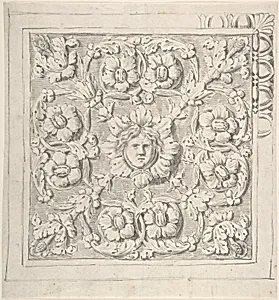
Classical Molding with Human Head at the Center Surrounded by Leaves and Vines
1776–79
Medium
Graphite
Dimensions
sheet: 9 11/16 x 9 in. (24.6 x 22.8 cm)
Classification
Drawings|Ornament & Architecture
Department
Drawings and Prints
Museum
Metropolitan Museum of Art, New York, NY
Credit
Harris Brisbane Dick Fund, 1934
Accession Number
34.78.2(73)
Rights
Public Domain
Tags
Art Historical Context
This graphite drawing by British architect Thomas Hardwick captures a refined study of classical architectural ornament from 1776–79. At its center, a sculpted human head emerges from swirling leaves and vines, framed within a molding design that evokes ancient Roman and Greek decorative traditions. Rendered with precise, delicate lines on a modest sheet, the work highlights Hardwick’s attention to naturalistic detail and symmetry. Created during the height of the neoclassical movement, the piece reflects the era’s fascination with antiquity, spurred by archaeological discoveries and the Grand Tour. Architects like Hardwick often produced such studies to inform building facades, interiors, and decorative elements, blending human forms with organic motifs to suggest vitality and harmony. Its classification as both a drawing and architectural ornament underscores its practical role in 18th-century design. Acquired by the Metropolitan Museum of Art in 1934, this intimate work offers visitors a glimpse into the creative process behind neoclassical architecture, where even small details carried cultural weight.