
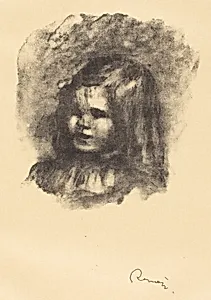
Claude Renoir, turned left (Claude Renoir, tourne a gauche)
1904
Medium
lithograph on japan paper [trial proof]
Classification
Department
CG-E
Museum
National Gallery of Art, Washington, D.C.
Credit
Rosenwald Collection
Accession Number
1943.3.7354
Rights
Public Domain
Art Historical Context
In this delicate lithograph titled *Claude Renoir, left (Claude Ren, tourne à gauche)*, created by Impressionist master Pierre-Auguste Renoir in1904, we see a tender portrait of his young son Claude captured in profile, gently turning his head to the left. Rendered as a trial proof fine Japan paper—a thin, high-quality Asian paper prized for its absorbency and subtle texture—this print exemplifies Renoir's late-career exploration of printmaking. Trial proofs like this were experimental pulls from the lithographic stone, allowing the artist to refine tones and details before final editions. Renoir, renowned for his luminous oil paintings of everyday joys, adapted his signature loose brushwork to lithography's fluid crayon and ink techniques, achieving soft, impressionistic effects through layered inking and subtle gradations. By 1904, arthritis limited his painting, drawing him to prints that preserved his affectionate gaze on family life. This work reflects his enduring humanism, turning personal moments into universal art. Housed in the National Gallery of Art's Rosenwald Collection—a treasure trove of master prints—this piece invites us to appreciate Renoir's innovative bridge between painting and print, blending spontaneity with precision for intimate, timeless appeal.
About the Artist
Auguste Renoir · 1841–1919
Pierre-Auguste Renoir (1841-1919) was a founding figure of Impressionism whose luminous depictions of Parisian leisure, sensuous female forms, and sun-dappled landscapes made him one of the most beloved painters in Western art history. Born in Limoges to a working-class family, Renoir began as a porcelain painter before pursuing fine arts, and this early craft experience gave him facility with the...