
Claviorganum
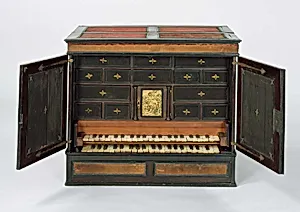
Medium
Wood, bone, ebony, metal, pear, quill, lead, leather, parchment
Dimensions
Instr. 74cm x 56cm x 61cm Stand: 78cm x 62cm x 100cm
Classification
Chordophone-Zither-plucked-virginal
Culture
German
Department
Musical Instruments
Museum
Metropolitan Museum of Art, New York, NY
Credit
The Crosby Brown Collection of Musical Instruments, 1889
Accession Number
89.4.1191
Rights
Public Domain
Art Historical Context
Step into the Renaissance world of sound with the *Claviorganum*, a masterful German keyboard instrument crafted in 8 by Lorenz Hausla and Steffan Cz. This rare chordophone—classified as a plucked zither-virginal—combines the delicate tang of quill-plucked strings with potential organ-like tones, embodying the innovative spirit of late 16th-century European-making. Compact at 74 x 56 x 61 cm, it sits elegantly on a sturdy stand (78 x 62 x 100 cm), perfect for intimate chamber settings where musicians explored polyphonic compositions by masters like Bach's predecessors. Expertly constructed from diverse materials—wood, bone, ebony, metal, pear wood, quill, lead, leather, and parchment—the *Claviorganum* showcases Renaissance craftsmanship. Ebony and bone likely adorn its keys and fittings, while quills and leather ensure precise, resonant plucking. Hailing from Germany, it reflects the era's fascination with hybrid instruments, bridging clavichord intimacy and organ grandeur, vital for both courtly entertainment and early Protestant worship. A gem of The Crosby Brown Collection of Musical Instruments, acquired in 1889, this piece at the Metropolitan Museum of Art invites visitors to ponder the artistry behind sound itself—where wood whispers and strings sing the harmonies of history.
About the Artist
Lorenz Hauslaib|Steffan Cuntz (German|German) · 1568 |1565 –1625 |1629
German, Nuremberg 1568–1625 Regensburg|German, ca. 1565–1629