
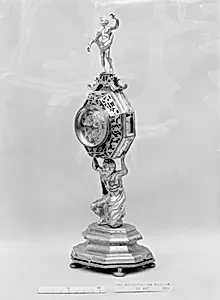
Clock
late 16th–early 17th century
Medium
Gilt bronze, crystal
Dimensions
Height: 8 5/8 in. (21.9 cm)
Classification
Horology
Culture
German, Augsburg
Department
European Sculpture and Decorative Arts
Museum
Metropolitan Museum of Art, New York, NY
Credit
The Friedsam Collection, Bequest of Michael Friedsam, 1931
Accession Number
32.100.225
Rights
Public Domain
Tags
Art Historical Context
This exquisite gilt bronze and crystal clock, crafted by Martin Zoller in late16th- to early 17th-centurysburg, Germany, exemplifies the golden age of German horology. Augsburg was a renowned hub for precision metalworking and clockmaking, where artisans like Zoller produced luxurious timepieces for the elite. Standing just 8 5/8 inches tall, this compact table clock reflects the era's fascination with mechanical ingenuity, blending functional innovation with opulent decoration during the transition from Renaissance to Baroque styles. The medium is particularly noteworthy: fire-gilt bronze provided a shimmering gold finish through mercury-gilding techniques, while the crystal case allowed viewers to admire the intricate clockwork inside—a novel feature that highlighted the maker's skill. Zoller's work, classified under horology in the Metropolitan Museum of Art's European Sculpture and Decorative Arts collection, entered the museum via The Friedsam Collection in 1931. Such clocks were status symbols, merging artistry with emerging scientific precision, and often featured figural motifs like men, evoking the period's humanistic themes. Visitors will appreciate how this piece captures Augsburg's legacy as a cradle of technical virtuosity, inviting a closer look at the delicate balance of form, function, and splendor.