
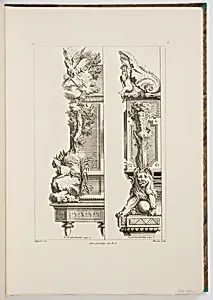
Clock Case Design
Medium
Bound print
Classification
Bound print
Department
Smithsonian Collection
Museum
Smithsonian American Art Museum
Credit
Purchased for the Museum by the Advisory Council
Accession Number
1921-6-230-14
Rights
Public Domain
About this artwork
Research in Progress
Art Historical Context
Gilles-Marie Oppenord (2–1742), a prominent French designer and architect, created this *Clock Case Design* as part of his influential work in ornamental arts. Active during the transition from Baroque to Rococo styles under Louis XIV and XV, Oppenord was renowned for his intricate, flowing motifs inspired by nature, shells, and asymmetry—hallmarks of early Rococo elegance. Clock cases like this one were prestige items for aristocratic homes, blending functionality with lavish decoration to showcase wealth and refined taste. Rendered as a bound print around 1900, this artwork likely reproduces one of Oppenord's original designs from his era, preserved in a volume for study or inspiration. The medium of bound prints was common for disseminating architectural and decorative patterns, allowing artisans across Europe to replicate opulent furnishings. Its presence in the Smithsonian American Art Museum's collection, acquired through the Advisory Council, underscores its value in tracing the evolution of design influences on American decorative arts. Though research continues, this piece invites us to appreciate how 18th-century French innovation shaped timeless luxury, bridging historical craftsmanship with modern admiration. (178 words)