
Clock
c. 1938
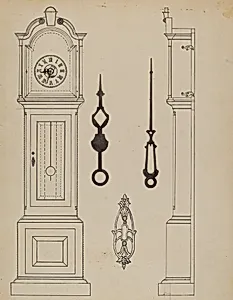
Medium
pen and ink, watercolor, colored pencil, and graphite on paperboard
Dimensions
overall: 31.4 x 24.3 cm (12 3/8 x 9 9/16 in.) Original IAD Object: 7'9"high; 2'1 1/2"wide
Classification
Index of American Design
Department
CG-W
Museum
National Gallery of Art, Washington, D.C.
Credit
Index of American Design
Accession Number
1943.8.4871
Rights
Public Domain
Art Historical Context
Behold the meticulously rendered *Clock* by Nicholas Gorid, created around 1938 as part of the Index of American Design (IAD). This vibrant watercolor, pen and ink, colored pencil, and graphite on paperboard (31.4 x 24.3 cm) captures towering original American timepiece standing 7'9" high and 2'1½" wide. Gorid's work exemplifies the IAD's mission to document everyday objects of American craftsmanship, preserving their forms and colors for posterity. Commissioned under the Federal Art Project of the Works Progress Administration during the Great Depression, the IAD employed artists like Gorid to produce over 15,000 detailed renderings of folk art, decorative arts, and design icons from across the U.S. This clock depiction highlights regional woodworking traditions, likely from the Northeast, where tall case clocks symbolized prosperity and ingenuity in colonial and early American homes. Gorid's masterful mixed-media technique brings the clock to life: precise pen lines define intricate carvings, while watercolor and colored pencil evoke rich woods, gleaming metals, and subtle patinas. Housed in the National Gallery of Art's collection, this piece invites us to appreciate how ordinary objects embody cultural heritage, bridging artistry and history in a single, striking image.
About the Artist
Nicholas Gorid · 1855–present
Nicholas Gorid (b. 1896) was an American artist best known for his meticulous contributions to the Index of American Design, a Works Progress Administration (WPA) Federal Art Project initiative launched in the 1930s to document the nation's rich heritage of decorative arts and folk objects. Active primarily from the mid-1930s through the early 1950s, Gorid produced highly detailed renderings of an...