
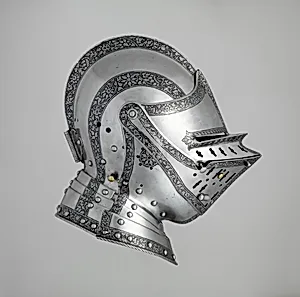
Close Helmet
ca. 1560
Medium
Steel, leather, copper alloy
Dimensions
H. 14 3/4 in. (37.5 cm); W. 9 1/8 in. (23.2 cm); D. 13 1/4 in. (33.7 cm); Wt. 11 lb. 3.1 oz. (5077.4 g)
Classification
Helmets
Culture
German, Landshut
Department
Arms and Armor
Museum
Metropolitan Museum of Art, New York, NY
Credit
Rogers Fund, 1904
Accession Number
04.3.267a
Rights
Public Domain
Art Historical Context
This exquisite close helmet, crafted around 1560 by the master armorer Wolfgang Grossched in Landshut, Germany, exemplifies the pinnacle of 16th-century European armor-making. Landshut was a renowned center for the craft, and Grosschedel's workshop produced pieces for nobility and knights during the late Renaissance, when plate armor reached its artistic and functional zenith. Worn by men-at-arms in battle or tournaments, the close helmet enclosed the entire head and neck, offering unparalleled protection via its pivoting visor and bevor (chin defense). Forged primarily from steel, with leather linings for comfort and copper alloy accents, this helmet weighs a substantial 11 pounds—reflecting its robust construction designed to withstand heavy blows. Its precise dimensions (height 14¾ inches, width 9⅛ inches, depth 13¼ inches) allowed for mobility while encasing the wearer like a second skin. Grosschedel's technique combined utilitarian strength with sculptural elegance, often featuring fluted surfaces for deflection and decoration, blending Gothic robustness with emerging Renaissance flair. Acquired through the Rogers Fund in 1904, this helmet now graces the Metropolitan Museum of Art's Arms and Armor Department, inviting visitors to ponder the blend of artistry and warfare in Renaissance Germany. A testament to human ingenuity, it reminds us how armorers like Grosschedel elevated protection into wearable masterpieces.